No wonder the media loves him —selling false hope is what they do best
Since his days in the Illinois state legislature Barack Obama's position on health care has consistently devolved. Once a bold champion of medical care as a human right, Senator and presidential candidate Obama has become a timid advocate of failed "market-based" health care solutions, taking his lead from the private health insurance industry, and unwilling or unable to expose even the most transparently fraudulent policies and claims perpetrated on behalf of his campaign contributors.
"Rather than educating us on the issues, American political campaigns are run on themes, images, and messages which are evocative, but content-free sound bytes."
If there's one thing the shot callers of America's political and media elite have proved, it's their willingness to lie to us. A law designed to gut and dismantle public education is named "No Child Left Behind." An act to let energy companies burn more coal is the Clear Skies Initiative. Legislation to shield giant corporations from lawsuits by consumers and the public is "tort reform," and the proposed privatization of Social Security is "social security reform."
Rather than educating us on the issues, American political campaigns are run on themes, images, and messages which are evocative, but content-free sound bytes. Think of Bush's "war on terrorism." Think of Clinton's "it's the economy, stupid." In a political culture so suffused with lies, where legislative leaders get their jobs based on who gets the most corporate campaign donations, and bait-and-switch is the norm the only sane response on the part of citizens is a big dose of skepticism toward whatever our elite media and politicians tell us.
Among the most potent sound bytes this political season are variants of "universal health care" and "national health care." Though both Republicans and Democrats alike favor it, whatever the terms mean on their lips, there are devils in the details which are far too complicated for ordinary mortals to understand. For their part, the media, which supposedly exist to explain these things to the public utterly fail to publicly examine the workings of a new wave of supposed "health care for all" plans which a few states have already adopted, and that several more are poised to consider.
Two of the new-style "universal health care" proposals favored by many Democrats and Republicans have recently been enacted in Massachusetts and California. These advanced and civilized commonwealths have both solved the problem of millions of uninsured poor by requiring the poor to buy their own health insurance from private vendors. If they don't the uninsured face draconian fines and tax penalties amounting to thousands of dollars a year per person, including the loss of one's personal exemption on state income tax.
"The core idea," explained Dr. Steffie Woolhandler, a practicing physician in Boston and co-founder of Physicians For A National Health Care Plan in a January 11 interview on Doug Henwood's Behind the News radio show, "is the uninsured are going to have to buy their way out of their predicament. The (California and Massachusetts) bills contain a so-called 'individual mandate' which says to uninsured families 'you must go buy health insurance, and if you make more than a certain amount of money we're not even going to help you. We're not even going to subsidize you'....

"We're talking about someone who earns $25 thousand a year being mandated, forced by law to go out and purchase private health insurance without any real help from the state. The average individual policy in... Massachusetts is about $6 thousand dollars per person, in California it's at least $5 thousand per person. So I just don't think you're going to see a lot of new health care, much new health insurance by telling someone who only earns $25 thousand that they have to take that kind of money out of their pocket.
"It's a little like Marie Antoinette" quipped Dr. Woolhandler, "The poor have no health insurance. So let them buy health insurance. People simply don't have the money. That's why they're uninsured in the first place. Most people would greatly prefer to have health care coverage. People are not uninsured by choice... But these plans have tremendous appeal to Republican types because they use the language of individual responsibility. But they also do the equivalent of placing a big tax on the uninsured people themselves. ...if you say to someone earning $30 thousand a year OK, you didn't buy health insurance, we're taxing you $3 thousand dollars, you're penalizing them $3000. That's a new tax revenue that's very regressive because it goes against the middle income families who can't afford insurance.
"..it's called an 'individual mandate', but in order to enforce the 'individual mandate' the government is using the tax code...to say...that you have to go out and give your money to a private health insurance firm.. to place huge tax penalties on people unless they hand over their money to a private, often investor owned profit seeking entity."
'Let them buy health insurance'
Many near-poor and middle class families will pay more than the average cost per individual - the uninsured with chronic illnesses, those with children, those in their forties and fifties. Unsurprisingly, this car insurance approach to health care reform is touted with a straight face as innovative and a giant step toward "universal health care" by a large number of establishment politicians including Ted Kennedy of Massachusetts, and Barack Obama of Illinois.
"The poor have no health insurance. So let them buy health insurance. People simply don't have the money. That's why they're uninsured in the first place."
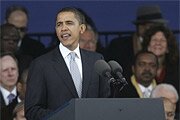
Last week, the media breathlessly announced that presidential aspirant Obama had delivered the first significant health care speech of his campaign, one in which he endorsed the principle of universal health care for all. This is what he had to say about the car insurance model of health care reform.
"..we have to start looking at some of the interesting ideas on comprehensive reform that are coming out of states like Maine and Illinois and California, to see what we can replicate on a national scale and what will move us toward that goal of universal coverage for all."
To be fair, Obama didn't specifically endorse the car insurance model, he only pronounced it "interesting." But it speaks volumes about the "leadership" style of this elite politician that he made no attempt either to educate the public on this "interesting" stuff, though he's certainly aware that its details are neither well known nor widely understood or to denounce it as a bad idea. However short Obama may have been on elucidations of proposed and actual policies, though he was long and strong on the rhetoric. Summoning the ghosts of Harry Truman and Lyndon Baines Johnson to his side, candidate Obama thundered that it was "time to act" on health care. But aside from putting all medical records online, he brought forth no new suggestions, and recommended no precise action.
"...one out of every four health care dollars - is spent on non-medical costs; mostly bills and paperwork. And we also know that this is completely unnecessary. Almost every other industry in the world has saved billions on these administrative costs by doing it all online....
"But because we haven't updated technology in the rest of the health care industry, a single transaction still costs up to twenty-five dollars - not one dime of which goes toward improving the quality of our health care...
"...if we brought our entire health care system online, something everyone from Ted Kennedy to Newt Gingrich believes we should do, we'd already be saving over $600 million a year on health care costs."
"Rather than ‘moving the conversation' on health care toward any practical solution, Senator Obama seems intent on keeping it vague and unfocused."
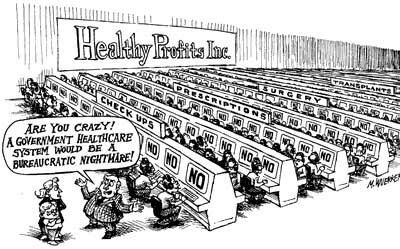
In the realm of public policy, this kind of pap is to real advocacy is like the fistful of meat-flavored bread enclosing the postage-stamp burgers at White Castle: lots of flavor concealing a lack of substance. Obama's suggestion if that computers do away with the "paperwork" the savings will show up in more health care is inane and misleading. Obama's neighbor, Dr. Quentin Young, an eminent Chicago physician, a past president of the American Public Health Association, and another co-founder of Physicians For a National Health Care Plan offers a more honest and complete assessment of where health care dollars go. Young has pointed out many times in recent years that a quarter of every U.S. medical care dollar ends up as the administrative overhead, including billing, advertising, shareholder returns and profit for the private insurance industry.
Computerizing the records won't make that go away, and Obama knows it. Only a "single payer" system of national health insurance, under which a governmental or quasi-governmental agency takes the place of greedy, profit-driven insurers and dispenses medical care as a human right instead of a commodity, can do that. But an honest national debate on the merits of single payer is the last thing candidate Obama and his backers in the private insurance industry want.
"We need national health insurance," explained Dr. Woolhandler in her Doug Henwood interview. "Every other developed country has some form of national health insurance and every other developed country spends less [per capita on health care] than we do. In fact the average among developed nations is that they only spend about half as much as we do, despite having universal coverage. So the national health insurance is a much more efficient way of covering everyone. You do get rid of all of the insurance overhead. Typical private insurance in this country is about 13%, but some of the HMOs go up to 20, even 25% overhead. 25% overhead means that the premium payer puts in a dollar but only 75 cents would ever come out for doctors, nurses, hospitals medications , the rest stays right there with the HMO...."