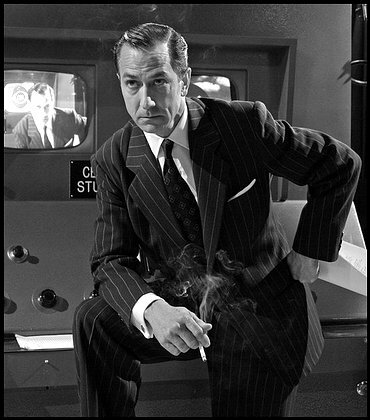
Herbert
Schiller, who passed away on
January 29 at the age of 80,
was possibly the most original
and influential media analyst
of the left in the past half
century, and he will be sorely
missed.
He
taught at the University of California
at San Diego for several decades,
but his influence derived also
from his extensive travels and
speaking engagements (he was
a superb and witty speaker),
and from his numerous books.
He had an extensive network of
intellectual allies in the
communications field, many of
whom contributed to a tribute
book to Schiller that reads like
an international Who's Who of
communication scholars (Becker,
Hedebro and Paldan, eds., Communication
and Domination: Essays to Honor
Herbert I. Schiller [1986]).
In his writings, he relentlessly
pursued all the major themes
essential to a critical understanding
of communication and the needs
of democracy. His first book,
Mass Communication and American
Empire (1969), spotlighted the
underrated role of the military
establishment in developing the
evolving communications technologies,
and the importance of this government-subsidized
communications technology in
facilitating domination within
and beyond U.S. borders.
Schiller never underestimated
the power of the military establishment
in U.S. society, and in 1970
co-edited Superstate:
Readings in the Military Industrial
Complex.
In Mass
Communication and American Empire, Schiller also placed
great weight on the commercialization
of the media, and the growth
of the advertising industry in
building the U.S. business empire
overseas and pressing commercialization
and consumerism at home and abroad.
The force of commercialization
spreading into every nook and
cranny of the society was perhaps
most tellingly spelled out in
his Culture
Inc.: The Corporate Takeover
of Public Expression (1989). This outstanding work
restates many Schiller themes,
but stresses particularly the
damaging effects of the ongoing
privatization of information
and education, and the corrosive
impact of media centralization
and commercialization on democracy.
It also has a powerful analysis
of the conservative-liberal defenses
of the media status
quo, including
a critique of so-called "active-audience" theory.
Schiller also forcefully argued
that the "free flow of information" --
including advertising -- is a
principle that serves imperial
ends and damages Third World
countries. With unequal power
relations, this "free flow" brings
dependency and a loss of cultural
as well as economic and political
autonomy; the need for "distance" as
well as aid has been underrated.
Another important theme of Schiller's
work was that technology is no
panacea, and that its effects
are closely connected to its
sponsors "for whose benefit
and under whose control it will
be implemented," as he wrote
in Mind
Managers (1972).
He stressed that technological
advance permits those who own
and sell to control and manipulate
consumers ever more; and that
it polarizes society, with the
information needs of the haves
now satisfied instantaneously
as the poor are left behind. "What
is occurring in the information
sphere can be observed in the
economy at large. The social
order is splitting into at least
a two-tiered structure, one with
a full and expanding range of
social amenities; the other with
a declining share of both, but
also with a growing amount of
junk food, junk entertainment,
junk information" (Information
Inequality, 1996).
Herb Schiller scoffed at the
touters and sponsors of each "revolution," from
radio broadcasting to the Internet,
who prophesied the opening of
a new democratizing era. The "revolution" awaits
democratic control, and in all
his immensely constructive life
Herb Schiller sought that objective.
--Edward S. Herman
Edward
S. Herman, professor
of finance at the Wharton
School, University of
Pennsylvania, is also
the author of Corporate
Power, Corporate Control (Cambridge,
1981), and Terror and
Propaganda (South End
Press, 1982), where he
continues the examination
of official propaganda
initiated in The Political
Economy of Human Rights, with
Noam Chomsky.