Whatever the attitudes of the U.S. leadership toward freedom at home--and this is an area that remains highly ambiguous--systematic policies towards the Third World make it evident that the alleged commitment to democracy and human rights so vociferously proclaimed by Washington through successive administrations is mere rhetoric, and directly contrary to actual policy. The operative principle in U.S. foreign policy has been and remains economic freedom--meaning by this the freedom for U.S. business, and capitalists in general, to invest, sell, and repatriate profits at will, on the basis of two essential conditions: the existence of a "favorable investment climate," and continuing "political stability."
As these primary values are easily disturbed by unruly students, democratic processes exercised in earnest, peasant organizations, a free press, and free labor unions, "economic freedom" has often required the imposition of widespread political servitude. In this context, the United States, against a propaganda backdrop of unparalleled moral hypocrisy, has eagerly supplied the tools and training for interrogation, torture, and, when needed, wholesale "pacification." America has thus emerged since the end of World War 11 as the world's chief sponsor of counterrevolution, state terror and neo-fascism.
But how did this monstrous state of affairs come to pass? In what fashion was it justified to the American people, and how did the media cover it up despite its self'‑assigned role of watchdog over the nation's moral rectitude? The answer to this question is necessarily complex, but two central areas, indissolubly linked and mutually reinforcing, provide a good departure point for analysis. They are the Cold War/National Security Syndrome and the (by now) widespread practice of ideological management and conformity throughout the U.S. and much of the Western media.
|
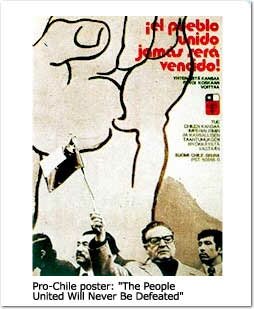
In poster above, Dr. Salvador Allende, Chile's martyred president, is seen waving the Chilean flag.
|
In and of itself establishment control over media contents in the U.S. is not a difficult task requiring absolute rigidity and compliance, provided that a significant number of media keep the informational ideological balance overwhelmingly on the side of the official worldview. Of course, the U.S. does not have at this point state censors, state control over all media, an omnipotent single party, marauding bands of jack‑booted thugs in charge of intimidation and assault on critics and opponents, and the rest of the repressive arsenal commonly found in clearly illegitimate regimes. What it does have is a far subtler and hence more difficult to spot and resist system of mind management, a system that up to this point boasts of its ability to accommodate all views, no matter how displeasing these may be for the powerholders. This boast should be carefully scrutinized, however, and never taken as if it were an immutable given. For the truth about the system's allegiance to its own proclaimed rules will be seen when the left and its publications truly begin to make a dent on the American opinion mainstream, shifting it away from the rotten confusion where it is presently lodged.
|
Only then will we see if the virtuous gentlemen who make so many sacrifices to preserve "freedom" around the world are truly serious about democracy and the Bill of' Rights at home.
However, if we understand correctly the nature of the beast, the more likely scenario is that confronted with a well‑organized and conscious mass movement, the self-assigned guardians of' democracy will declare that the rules of the game are being "abused" and that, in order to preserve representative government and save it from "chaos," which, incidentally, could be manufactured to order by provocateur squads working for the government, it is now (painfully) necessary to put democracy to bed . In this regard, the advice proferred by the political physicians hired by the Trilateral Commission to study democracy's "distemper—that is, the "threats" posed by the democratic spirit and the "overload of government" to the legitimacy of authority—is highly illuminating. Speaking darkly about the eroding "governability” of democracies the Trilateral diagnosticians have this to say:
(T)he pursuit of the democratic virtues of equality and individualism has led to the delegitimation of authority generally and the loss of trust in leadership. The democratic expansion of political participation and involvement has created an “overload" on government and the imbalanced expansion of governmental activities, exacerbating inflationary tendencies in the economy.
And later in the text,
Every social organization requires, in some measure, inequalities in authority and distinctions in function. To the extent that the spread of the democratic temper corrodes all these, exercising a leveling and an homogenizing influence, it destroys the bases of trust and cooperation among citizens and creates obstacles to collaboration for any common purpose. (The Crisis of Democracy, M. Crozier, S.P. Huntington, J. Watanuki, New York University, 1975) (italics ours)
Leaving the elegant mumbo-jumbo aside, it's clear that the above ruminations could not have been penned by a believer in authentic democracy. But, then, it is not too difficult to see whose authority and which socioeconomic order the authors are worried about. If the history of our species is any guide, people do not become impatient and disenchanted with "authority" or "leadership" as disemboweled categories, but only with very specific social arrangements which may be discovered to be against their interests. Thus, in our country, or, for that matter, in the rest of the Western bloc, the people are not threatening democracy with their demands, but, more precisely, a system of pseudo-democracy in which oligarchic power, in the name of democracy, controls and co-opts all major policy decisions affecting the national well‑being. The real subversives are within the system, not among the powerless.
OVER THE YEARS, capitalist democracy in the U.S. has spawned a very vast system of ideological manipulation in order to survive and go on legitimating itself. It is a fair assumption that if the American people knew more about the true purpose and nature of our foreign policy of "pragmatic" support for brutal fascists, they might reject it altogether, leaving the ruling orders in something of a lurch. It is important, therefore, to understand how the news‑stream is processed by the mind managers, to decide which items deserve inclusion, exclusion, downplay or distortion. Consider, if you will, why was it so "natural" to look upon the Iran hostage crisis as one deserving saturation and jingoist coverage (with similar treatment accorded Lech Walesa and Solidarity in Poland), while Tucapel Jimenez, the very moderate leader of the Chilean workers' struggle, could be shot and stabbed by the junta goons in total media silence and impunity. And how do the bulk of practicing journalists arrive at the proper slant to handle politically delicate issues? As suggested before, there is no conspiracy to misinform the public in the U.S., if by that we understand a system of mass communications manned by journalists and writers consciously dedicated to manipulation The problem is far more subtle, as the ideological bias is built into media messages mainly as a result of factors such as these:
The media share, by and large, the political values and prejudices of the System, thus making their "regurgitation" seem natural and an act of "free will. " Furthermore, as the case of El Salvador illustrates, the global interests of the media bourgeoisie, as a class of super-propertv owners, agree totally with the counter‑revolutionary intentions of' tile American government even though dissension may sometimes give tile impression of an independent stance, However it is usually methods, not goals, that are questioned. Moreover, correspondents such as Raymond Bonner of the (New York) Times, who has shown how powerful (and embarrassing) the truth can be when given even a tepid chance, represent a young and extremely fragile phenomenon subject to cancellation at a moment's notice. [Bonner was cancelled, pulled off his beat, relegated to invisibility in the Times' bureaucracy.—Eds.]
The media in America suffer seriously from the flaws and shortcomings inherent in treating them as businesses, or as simple merchandising vehicles for economic and political propaganda. The "scoopism" syndrome, the patent imbecilities observed in the staffing of media at all levels, the pronounced desire to avoid controversy at all costs and present, instead, escapist and mind‑numbing fare‑all these are logical and inevitable in a system left entirely to the logic of profit.
Media owners and their agents, usually of conservative persuasion, easily control contents through their rights of ownership. Top editors are hired (and fired) for their capacity to please the owner, financialIy and politically. A diffuse but effective political "line" is thus frequently established, a situation that also helps in the screening off of potential "troublemakers," especially at the point of hiring. Thus, many American journalists don't have to be disciplined by the State censors. That job has already been done by the personnel office and the rounds of interview that most candidates must survive in order to land and keep anything resembling a decent and promising position.
Finally, and perhaps most important, the Cold War and the ideological war waged on socialism since the birth of' the Soviet Republic have created an "established" set of practices and techniques of misinformation, news suppression and deleterious journalistic reflexes throughout the U.S./Western media that seriously disfigure most contemporary issues
Below we have sought to analyze how these various techniques and prejudices have affected the presentation of news about the Third World, and foreign affairs, in general.
jjjjjThe semantics of "terror"
Among the many symbols used to frighten and manipulate the populace of democratic states, few have been more important than "terror" and "terrorism." These terms have generally been confined to the use of violence by individuals and marginal groups. Official violence, which is far more extensive in both scale and destructiveness, is placed in a different category altogether. This usage has nothing to do with causal sequence, or numbers abused. Whatever the actual sequence of cause and effect, official violence is described as responsive or provoked ("retaliation," "protective reaction," etc.), not as the active and initiating source of abuse. Similarly, the massive long-term violence the oppressive social structures that U.S. power has Supported or imposed is typically disregarded. The numbers tormented mid killed by state violence- wholesale as opposed to retail terror-during recent decades have exceeded those of' unofficial terrorists by a factor running into the thousands But this is not "terror", although one terminological exception may he note& w hile Argentinian "security forces" only retaliate and engage g ge in "police action," violence carried out by unfriendly states (Cuba, Cambodia) in a ay tic d es i ig gn at t cc! "terroristic" The question Of proper usage is settled not merely by the official or unofficial status Of the perpetrators of violence but also by their political affiliations.
These terminological device serves important functions- that help to justify the far more extensive violence of (friendly) state authorities by interpreting them as "reactive," and they implicitly sanction the suppression of information on the methods and scale of official violence by removing it from the category of "terrorism." Thus in Latin America, "left-wing" terrorism is quiescent after a decade and a half of turmoil," the New York Times explains in a summary article on the state of terrorism; it does not discus any other kind of violence in Latin America-CIA, Argentinian and Brazilian death squads, DINA, etc. Their actions are excluded by definition, and nothing is said about the nature and causes of this "turmoil." Thus the language is well-designed for apologetics for wholesale terror.
This language is also useful in its connotation of irrational evil, which can be exterminated
without questions asked. The criminally insane have no just grievance that we need trouble to comprehend. On the current scene, for example, the New York Times refers to the "cold-blooded and mysterious" Carlos; the South African government, on the other hand, whose single raid on the Namibian refugee camp of' Kassinga on May 4, 1978 wiped out a far larger number of people (more than 600) than the combined victims of Carlos, the Baader-Meinhof gang, and the Italian Red Brigades, is not referred to in such invidious terms. Retail terror is "the crime of our times" in the current picture of reality conveyed by the media; and friendly governments are portrayed as the reassuring protectors of the public, striving courageously to cope with "terror"
The limited concept of "terror" also serves as a lightning rod to distract attention from substantive issues, and helps to create a sensibility and frame of mind that allows greater freedom of action by the state. During the Vietnam War, students were the terrorists, and the government and mass media devoted great attention (and much outrage) to their frightful depredations (one person killed, many windows broken). The device was used effectively to discredit the antiwar movement as violence-prone and destructive the motive, of course, for the infiltration of tile movement by government provocateurs and it helped to divert attention from the official violence that was far more extensive even on the home front, not to speak of Vietnam, the Dominican Republic, and elsewhere. The ploy was amazingly successful in light of the facts, now documented beyond serious question, even though it did not succeed in destroying, the antiwar movement. The terrorism of the Vietnamese enemy was also used effectively in mobilizing public opinion, again a tremendous testimonial to the power of brainwashing under freedom, given the real facts of the matter.
The shift in the balance of terror to the "free world"
Over the past 25 years at least, not only has official terror been responsible for torture and killing on a vastly greater scale than its retail counterpart, but, furthermore, tile balance of terror appears to have shifted to the West and its clients, with the United States setting the pace as sponsor and supplier. The old colonial world was shattered during World War II and the resultant nationalist-radical upsurge threatened traditional Western hegemony and the economic interests of Western business. To contain this threat the United States has aligned itself with elite and military elements in the Third World whose function has been to contain the tides of change. This role was played by Diem and Thieu in South Vietnam and is currently served by allies such as Mobutu in Zaire, Pinochet in Chile, Suharto in Indonesia, and the Salvadoran Junta. Under frequent U.S. sponsorship the neo-fascist National Security State and other forms of authoritarian rule have become the dominant mode of government in the Third World. Heavily armed by the West (mainly tile United States) and selected for amenability to foreign domination and zealous anti-Communism, counter-revolutionary regimes have been highly torture- and bloodshed-prone.
In the Soviet sphere of influence, torture appears to have been on the decline since the death of Stalin. In its 1974 Report on Torture, Amnesty International (AI) notes:
Though prison conditions and the rights of the prisoners detained on political charges in Eastern Europe and the Soviet Union may still be in many cases unsatisfactory, torture as a government-sanctioned, Stalinist practice has ceased. With a few exceptions (see below) no reports on the use of torture in Eastern Europe have been reaching the outside world in the past decade.
In sharp contrast, torture, which "for the last two or three hundred years has heen no more than a historical curiosity has suddenly developed a life of its own and become a social cancer." Since it has declined in the Soviet sphere since the death of Stalin, it would appear that this cancerous growth is largely a Free World phenomenon. It has shown phenomenal growth in Latin America, where, as Al points out:
There is a marked difference between traditional brutalitv stemming from historical conditions, and the systematic torture which has spread to many Latin American countries . within the past decade.
Amnesty International also notes that in some of the Latin American countries "the institutional violence and high incidence of political assassinations has tended to overshadow the problem of torture." The numbers involved in these official (wholesale) murders have been large. For example, Al estimates 15,000 death squad victims in the small country of Guatemala between 1970 and 1975, a thousand in Argentina in 1975 before the military coup and the unleashing of a true reign of' terror.
The Al Annual Report for 1975-1976 also notes that "more than 80% of the urgent appeals and actions for victims of human torture have been coming from Latin America." One reason for the urgency of these appeals is the nature of this expanding empire of violence, which bears comparison with some of the worst excrescences of European fascism. Hideous torture has become standard practice in the U.S. client fascist states. In the new Chile, to savor the results of the narrow escape of that country from Communist tyranny:
Many people were tortured to death (after the military coup of 19731 by means of endless whipping as well as beating with fists, feet and rifle butts. Prisoners were beaten on all parts of the body, including the head and sexual organs. The bodies of prisoners were found in the Rio Mapocho, sometimes disfigured beyond recognition. Two well-known cases in Santiago are those of Litre Quiroga, the ex-director of prisons under the Allende government, and Victor Jara, Chile's most popular folksinger. Both were detained in the Estadio Chile and died as a result of the torture received there. According to a recurrent report, the body of Victor Jara was found outside the Estadio Chile, his hands broken and his body badly mutilated. Litre Quiroga had been kicked and beaten in front of other prisoners for approximately 40 hours before he was removed to a special interrogation room where he met his death under unknown circumstances.
Such horrendous details could be repeated for many thousands of human beings in Argentina, Brazil, Chile, Uruguay, Paraguay, Guatemala, El Salvador, Indonesia, U.S.-occupied South Vietnam up to 1975, and in quite a few other U.S. client states. They clearly reflect state policy over a wide segment of the U.S sphere of influence. As already noted, much of the electronic and other torture gear was U.S. supplied, and great numbers of client state police and military interrogators are U.S.-trained.
Latin America has also become the locus of a major diaspora, with hundreds of thousands of academics, journalists, scientists, and other professionals, as well as liberals and radicals of all social classes, driven into exile. This has been a deliberate policy of the military juntas, which one distinguished Latin American journalist calls a "lobotomization" of intellect and the "cultural genocide of our time," with the purpose of removing any source of social criticism or intellectual or leadership base for the general population. Another aspect of the same strategy, of course, the widespread use of torture and political assassinations to create "a climate of fear and uncertainty to discourage any form of opposition to the ruling elite." To find comparable flights into exile on a continental scale, one would have to go back to the experience of fascist Europe, 1933-1940, which provides numerous parallels.
The churches versus the totalitarlan free enterprlse 'development model'
The client fascist states have behaved with such inhumanity toward the majority of their populations that the conservative churches throughout the U.S. sphere of influence have been driven into an unprecedented opposition, again reminiscent of fascist Europe. The military juntas and assorted dictators have allied themselves with a small local elite and foreign businesses and governments in a joint venture to exploit both the local resources and the 80% or more of the population whose welfare is of no interest to these joint venture partners. An important function of the military juntas has been to destroy all forms of institutional protection for the masses, such as unions, peasant leagues and cooperatives, and political groupings, making them incapable of defending themselves against the larger interests served by the state. As in Europe in the 1930s, only the church has survived as a potential protector of the majority.
The development model applied by the partners is so blatantly exploitative that it has required terror and the threat of terror to assure the requisite passivity. Church documents point out with pungency how the chosen model of development "provokes a revolution that did not exist" and necessitates a National Security State because its brutalities would elicit such indignation "that the only solution has been to impose absolute silence. "
This and numerous other church cries of protest have received minimal attention in the United States. The "development model" in question is serviceable to U.S. economic interests, one of the joint venture partners, so that the imposition of "absolute silence" by terror is given a respectful, parallel and almost complete silence in the heartland of freedom. The imposition of the development model will be interpreted there, as in a New York Times editorial on Brazil, as a bold showing of "more intent on applying corrective medicine than on courting political favor," with "an early tackling of social reforms" likely to follow a recovery already in sight. In short, the churches and people of Latin America and the rest of the client fascist empire stand alone.
How the media cope with client fascist terror (I): Suppression plus emphasis on the positive
|
Since the installation and support of military juntas, with their sadistic tortures and bloodbaths, are hardly compatible with human rights, democracy and other alleged Western values, the media and intellectuals in the United States and Western Europe have been hard pressed to rationalize state policy. The primary solution has been massive suppression, averting the eyes from the unpleasant facts concerning the extensive torture and killing, the diaspora, the major shift to authoritarian government and its systematic character, and the U.S. role in introducing and protecting the leadership of this client fascist empire. When the Latin American system of torture and exile is mentioned at all, it is done with brevity and "balance." The latter consists of two elements: one is the regular pretense that terror is a response to left-wing guerrilla terror and that the killings on each side are in some kind of rough equivalence. The second is the generous and preponderant attention given to the rationales, explanations and claims of regret and imminent reform on the part of the official terrorists. When elements of the mass media go a little beyond this pattern, as they do on occasion, their efforts are not well-received by other members of the establishment. Thus, an unusually frank ABC documentary on "The Politics of Torture" was greeted by the New York Times with petulance and hostility for failing to see the problems posed by "security and economic interests" and/or neglecting the abuses of the Communists.
Although, as noted, the torture and killing of political prisoners appears to be more extensive in the Free World than in the Soviet Union and its satellites, the mass media do not dramatize the abuse of individuals in our client states as they do in the case of Soviet intellectuals. Russian dissidents are international heroes, and their trials, personal and legal, and proclamations on all sorts of political and cultural issues, receive front-page attention. Who has even heard the names of their vastly more numerous counterparts in the U.S. client states?
|
 |
The mass media also feature heavily the positives of our military juntas, especially any alleged "improvements"--release of political prisoners, an increase in GNP, an announced election to be held in 1984, or a slowing up in the rate of inflation--typically offered without reference to a base from which the alleged improvement started. The parlous state of affairs that made the military takeover a regrettable necessity is also frequently emphasized, in preference to any discussion of the needs and interests of international capital. The military juntas and dictators in the U.S. sphere of influence have become quite adept at making the appropriate gestures, timed to coincide with visits of U.S. dignitaries or congressional consideration of budget appropriations. By these tokenistic and public relations devices the dictators demonstrate improvement, our leaders show that we are a force for liberty, and possibly a small number of prisoners may be freed, all this without seriously disturbing the status quo. Client fascist tokenism is often a collaborative effort of dictator and U.S. sponsor, both concerned with improving an image without changing anything fundamental. The Free Press can be counted on to accept these tokens at face value and without analysis or protest.
A striking example of these procedures is the case of Iran, where a brief experiment with democracy and independence was terminated by a CIA-sponsored coup in 1953, leading to the imposition of a regime that became one of the terror centers of the world. According to a report of the International Commission of Jurists:
The tremendous power wielded by the SAVAK (secret police) is reflected in the fact that the chief is given the title of Deputy Prime Minister. The SAVAK permeates Iranian society and is reported to have agents in the political parties, labor unions, industry, tribal societies, as well as abroad--especially where there are concentrated numbers of Iranian students.
The number of officially acknowledged executions of political prisoners in the three years prior to 1977 was some 300; and estimates of the total number of political prisoners run from 25,000 to 100,000. They are not well-treated. Martin Ennals, Secretary-General of Amnesty International, noted that Iran had the
... highest rate of death penalties in the world, no valid system of civilian courts and a history of torture which is beyond belief. No country in the world has a worse record in human rights than Iran.
The Iranian secret police received generous training and support from the United States, which deluged its Iranian client with arms, "priming" it, as a Senate report noted, to serve as the gendarme for U.S. interests throughout the crucial oil-producing regions of the Middle East. When the Iranian people rose in an astonishing and completely unexpected demonstration of mass popular opposition to the terror and corruption of the Shah, the Free Press obediently described this bloody tyrant as a great "liberalizer" who was attempting to bring to his backward country the benefits of modernization, opposed by religious fanatics and left-wing students. Newsweek described the demonstrators as "an unlikely coalition of Muslim fundamentalists and leftist activists" (22 May 1978) while Time added that "the Shah also has a broad case of popular support" (5 June 1978). Citing these and many other examples in a review of press coverage, William A. Dorman and Ehsan Omad write that,
"We have been unable to find a single example of a news or feature story in the mainstream American press that uses the label 'dictator' to describe the Shah."
There is barely a mention in the media of the facts on the magnitude of corruption, the scale of police terror and torture, the significance of the fantastic expenditures for arms--the police and military establishments are probably the only elements of Iranian society that could be described as fully "modernized"--and the devastating effects on the majority of the population of the agricultural reforms and urban priorities.
As the Shah's U.S.-armed troops murdered hundreds of demonstrators in the streets, President Carter sent his support, reaffirming the message he had delivered in Teheran several months earlier, when he stated at a banquet:
Iran under the great leadership of the Shah is an island of stability in one of the more troubled areas of the world. This is a great tribute to you, Your Majesty, and to your leadership, and to the respect, admiration and love which your people give to you…
Meanwhile, the Pentagon dispatched arms and counterinsurgency technology, while the press deplored the failure of the Iranian people to comprehend the Shah's beneficence or described him as "not repressive enough--the "saddest aspect of developments in Iran," according to the liberal New Republic. Much emphasis was placed, as usual, on his promises of reform. The servility of the media could hardly have been more dramatically displayed. Certainly, none of the Khomeini regime's barbaric features can serve to deny this shameful record.
The annual survey of human rights put out by the U.S. State Department has this primary characteristic: it strives consistently and without intellectual scruple to put a good face on totalitarian states within our sphere of influence. The bias is so great, the willingness to accept factual claims and verbal promises of military juntas is so blatant, the down-playing of the claims and pain of the victims of official terror is so obvious, that these reports are themselves solid evidence of the primary official commitment to the dispensers of terror rather than its victims. They constitute a defense of client fascism, not of human rights. The highly touted "human rights program" must be understood in this context.
The technique of "emphasizing the positive" is also used in other ways to whitewash the behavior of the prime sponsor of Third World fascism. A familiar device is the self-congratulation that regularly attends any decrement in barbarism or aggression. For example, the regular Washington correspondent of the New Yorker, regarded as a leading liberal commentator, wrote in 1974 that "we have brought ourselves satisfaction and at least a modicum of self respect by withdrawing our combat troops from Indo-China The Washington Post also assures us, in an editorial retrospective on the "good impulses" that led to such tragic error in Vietnam, that the United States "in the last days, made what seems to us an entirely genuine and selfless attempt to facilitate a political solution that would spare the Vietnamese further suffering”--very touching, after a quarter-century of brutality and terror, and also untrue.
Perhaps a search through the records of Murder Inc. would also reveal documents praising the thugs in charge for their display of humanitarian benevolence in offering a temporary respite to its victims.
How the media cope with client fascist terror (II): The pretense that the U.S. is an innocent bystander, rather than sponsor and supporter of client fascism
The military juntas of Latin America and Asia are our juntas Many of them were directly installed by us or are the beneficiaries of our direct intervention, and most of the others came into existence with our tacit support, using military equipment and training supplied by the United States. Our massive intervention and subversion over the past 25 years has been confined almost exclusively to overthrowing reformers, democrats, and radicals-we have rarely "destabilized" right-wing military regimes no matter how corrupt or terroristic. This systematic bias in interventions is only part of the larger system of connections--military, economic, and political--that have allowed the dominant power to shape the primary characteristics of the other states in its domains in accordance with its interests.
The Brazilian counterrevolution took place with the connivance of the United States and was followed by immediate recognition and consistent support, just as in Guatemala ten years earlier and elsewhere, repeatedly. The military junta model has been found to be a good one, and the United States has helped it flourish and spread. Torture, death squads and freedom of investment are related parts of the approved model sponsored and supported by the leader of the Free World. Terror in these states is functional, improving the "investment climate," at least in the short-run, and U.S. aid to terror-prone states is positively related to terror and improvement of investment climate and negatively related to human rights. It turns out, therefore, that if we cut through the propaganda barrage, Washington has become the torture and political murder capital of the world. Torture and political murder in the United States itself are absolutely and relatively low, and obviously provide no basis for such a harsh judgment. But the United States is the power center whose quite calculated and deliberate policy and strategy choices have brought about a system of clients who consistently practice torture and murder on a terrifying scale.
Some of the regimes in our sphere of influence have a fair amount of autonomy and may do things on occasion that our leadership does not like, much as Rumania or Poland in Eastern Europe may press the limits of Russian tolerance. When Guatemala or the Dominican Republic go too far in seeking independence or major socioeconomic change incompatible with the approved model, however, the mailed fist will strike, as in Hungary or Czechoslovakia. Brazil, a substantial power in its own right, can go its own way in part, though how far is not clear; it was only as far back as 1964 that the United States intervened to help mold Brazil into a state more to the taste of the U.S.-business community. The U.S. sphere of client states is as homogeneous--and as agreeable to the interest of the dominant power--as the states of Eastern Europe in relation to the USSR.
It is convenient to pretend that Guatemala, South Korea and the Philippines are "independent" in contrast to Rumania, Poland, and Hungary which are "puppets" of the Soviet Union. In this manner U.S. responsibility for terror in its sphere can be dismissed, while the Soviet Union's imposition of tyranny and crushing of freedom in its sphere can be sanctimoniously deplored. Given our role in creating and sustaining our terror-prone clients, our training and supply programs, our continued support for them on all fundamentals, their relative homogeneity and role in the U.S.-dominated global economy, their alleged Independence and our posture of innocent and concerned bystander must be taken simply as principles of state propaganda.
How the media cope with client terror (III): “Atrocities management” and the demand for communist abuses
Another established technique for diverting attention from the ongoing torture and bloodbaths and deteriorating social-political environment in Argentina, Brazil, Chile, the Dominican Republic, and Indonesia (to cite a few examples) is to concentrate attention on Communist abuses, real and mythical. Although Communist terrorism in Vietnam was always relatively modest compared to that of the Saigon government, and paled into virtual insignificance when compared to our own, the U.S. government and mass media created the opposite impression by selective emphasis of fact, outright lies, and a very effective program of “atrocities management." The contention by right wing critics of the press that the media overplayed our bad behavior and understated that of the Vietnamese enemy can be properly interpreted in this way: if the disproportion of violence was 100 (U.S.) to I (NLF), and the media attention ratio was 1:1, then while the media would have been underplaying our violence by 100:1, the right-wingers had a point that we were still allowed to see something of what we were doing to our victims. Nevertheless, as we show in the text below, the media's massive suppressions and institutionalization of lies and myths in the face of one of the most savage attacks on a helpless population in history, does it credit as an effective instrument of state propaganda.
This is not an absolute, however. The media occasionally present a glimpse of the real world of sub-fascist terror, a departure from orthodoxy that evokes predictable outrage on the part of guardians of the faith. Tom Buckley's New York Times review of the ABC documentary on torture in the U.S. sphere nicely illustrated the techniques that are used to overcome such occasional deviations. According to Buckley, ABC can't get it through its head that the United States “cannot easily transform repressive and unstable governments into humane ones. . ." and that "the United States, despite its best intentions, must balance what are perceived as its security and economic interests with the effort to improve human rights." Typically, it is presupposed, not argued, that the United States has "good intentions" but is limited in its ability to bring about reforms. Buckley evidently "can't get it through his head" that the United States has in fact imposed and supported these repressive governments and provided them with the means to remain "stable" in the face of popular reaction to their torture and repression.
Buckley complains further that the ABC documentary "fails to establish a historical or social context," by which he means: fails to provide appropriate apologetics for the U.S. role. His comment is particularly interesting in the light of the fact that ABC, in a rare departure from the standards of the Free Press, did in fact make some mention of the role of U.S. economic interests in the subfascist empire; that is, did touch on the actual historical and social context, a serious lapse from the point of view of the New York Times. Buckley further laments the failure of the documentary to point out that "we haven't done badly on behalf of the Jews of the Soviet Union"--which is false, but even if true would be about as relevant as a defense of Soviet human rights practices by a Russian Buckley who objects that "we haven't done badly on behalf of the Wilmington 10." Finally, in this review of a documentary focusing on Chile, Iran and the Philippines, Buckley writes: "More to the point is the fact that Communist dictatorships" do not permit free inquiry into their repressive practices. Why this has any point bearing on the facts of torture in the U.S. client states or proper U.S. policy towards that problem, Buckley fails to explain.
In the post-Vietnam War era the need for Communist abuses has been no less pressing than before. More facts have come to light on the scope of U.S. violence in Vietnam, Cambodia and Laos, the extent to which U.S. officials lied to the public with regard to their programs and methods, and the brazenness with which these officials defied treaty obligations and international law. Much as the government and the media tried to isolate the scoundrelism of Watergate from the much more profound immorality of the "secret" devastation of Cambodia, the linkage between the two could not be entirely concealed and therefore tended to discredit still further the campaign to bring "freedom" to South Vietnam. Counterrevolution, torture and official murder in Argentina, Guatemala, Chile, and other U.S. satellites was also reaching new peaks. Thus, if Cambodian terror did not exist, the Western propaganda system would have had to invent it.
THREE FEATURES OF THE PROPAGANDA CAMPAIGN WITH REGARD to Cambodia deserve special notice. The first is its vast and unprecedented scope. Editorial condemnation of Cambodian "genocide" in the mainstream media dates from mid 1975, immediately following the victory of the so-called "Khmer Rouge." After that time the Western media were deluged with condemnations of Cambodia, including not only regular reporting in the press and news weeklies but also articles in such mass circulation journals as the Reader’s Digest (with tens of millions of readers in the United States and abroad), TV Guide, and for the intellectual elite, the New York Review, the New Republic, etc. In contrast, interpretations of developments in Cambodia that departed from the theme of systematic genocide received virtually no attention. The volume of the chorus proclaiming "genocide" and the careful exclusion of conflicting facts (and the context or history) made the occasional expression of skepticism appear pathological, much as if someone were to proclaim that the earth is flat.
A second major feature of the propaganda campaign was that it involved a systematic distortion or suppression of the highly relevant historical context as well as substantial fabrication--the grim reality evidently did not suffice for the needs of propaganda--and fabrication persisted even after exposure, which was regarded as irrelevant in the face of a "higher truth" that is independent of mere fact. Furthermore, the more inflated the claims and the more completely the evidence was presented in a historical vacuum, attributed strictly to Communist villainy, the greater the audience likely to be reached.
A third striking feature of the campaign was the constant pretense that the horrors of Cambodia are being ignored except for the few courageous voices that seek to pierce the silence, or that some great conflict was raging about the question of whether or not there have been atrocities in Cambodia. In France and the United States, in particular, such pretense reached comic proportions. This particular feature of Western propaganda was apparently internalized by the intelligentsia, who came to believe it in dramatic defiance of the obvious facts. To cite one example, in the New York Times (22 September 1977) the well-known philosopher Walter Kaufmann, often a thoughtful commentator on moral and political issues, had an article entitled "Selective Compassion" in which he contrasts "the lack of international outrage, protests, and pressure in the face of what has been going on in Cambodia" with the compassion that is felt for the Arabs under Israeli military occupation. His comparison is doubly remarkable. By September 1977, condemnation of Cambodian atrocities, covering the full political spectrum with the exception of some Maoist groups, had reached a level and scale that has rarely been matched, whereas the situation of the Arabs under Israeli military occupation (or indeed, in Israel itself) is virtually a taboo topic in the United States. For example, the U.S. media are outraged over the fact that children work in Cambodia (rarely inquiring into conditions or circumstances or comparing the situation in other peasant societies), but accept with equanimity what is called in Israel "the Children's market," where children as young as six or seven years old are brought at 4 a.m. to pick fruit at subsistence wages or less for Israeli collective settlements. Similarly the odes to Israeli democracy that are a constant refrain in the U.S. media are careful to exclude any mention of the fact that a system of quasi-national institutions has been established (to which U.S. citizens make tax-deductible gifts) to ensure that land use and development funds are reserved to those Israeli citizens who are Jews--comparable anti-Semitic regulations in the Soviet Union would be a major scandal, and would certainly not be subsidized by the U.S. government. Even the human rights organizations in the United States have been scrupulous in suppressing information about the treatment of Arabs.
In the light of the indisputable facts, how can we explain the fact that a literate and serious person can believe that "selective compassion" in the United States is devoted to Arabs under Israeli rule while "strikingly" avoiding what has been going on in Cambodia, and can express this astonishing view without challenge--indeed, it is received with sage nods of approval. Only on the assumption that Arabs intrinsically lack human rights, so that even the slightest attention to their fate is excessive, whereas the principles of Western ideology are so sacrosanct that even a vast chorus of condemnation of an enemy still does not reach some approved standard--that is, only by a combination of chauvinist and racist assumptions remarkable when spelled out clearly, though standard among the Western intelligentsia.
Cambodia: why the media find It more newsworthy than Indonesia and East Timor
The way in which the media latched on to Cambodian violence, as a drowning man seizes a lifebuoy is an object lesson as to how the U.S. media serve first and foremost to mobilize opinion in the service of state ideology. When somewhere between 500,000 and a million people were butchered in the anti-Communist counterrevolution of 1965-1966 in Indonesia, almost total silence prevailed in Congress and in editorials in the U.S. press--a few tut-tuts, many more "objective" statements of how this is beneficially affecting the structure of power in Southeast Asia, how it shows the effectiveness of our Vietnam strategy, which is providing a "shield" for "democracy in Asia," and some suggestions that the "Communists" got what they deserved in a spontaneous uprising of "the people." This bloodbath involved approved victims and a political change consistent with U.S. business and strategic interests--what we refer to as a "constructive bloodbath" in the text below. Even today, as regards East Timor, where our corrupt and brutal Indonesian satellite (authors of the 1965-1966 butcheries) has very possibly killed as many people as did the Khmer Rouge, there is a virtually complete blackout of information in the Free Press. This is a bloodbath carried out by a friendly power and is thus of little interest to our leaders. It is a "benign bloodbath" in our terminology.
An effective propaganda apparatus disregards such cases of violence. It also downplay lesser but significant terror and bloodshed such as has prevailed in Argentina in the years 1975-78 since, in the words of David Rockefeller, "I have the impression that finally Argentina has a regime which understands the private enterprise system." Important lessons are not to be drawn from official terror in states that understand the private enterprise system, but Cambodian terror, could usefully be served up to the U.S. public on an almost daily regimen.
Media self-censorship: Or why two Soviet dissidents are worth more than 20,000 tormented Latins
The system of self-censorship, which pursues Communist abuses avidly while studiously ignoring the terror-ridden states of Latin America, is not a product of any explicit conspiracy. There are powerful governmental and media interests that do try deliberately to dredge up Communist abuse stories as part of a systematic effort at brainwashing. But most media agencies engage in the same kind of selectivity out of their own ideological conditioning and the pressures of larger interests that encourage attention to Communist terror and discourage undue attention to abuses in client states. There are no powerful interests embarrassed by tales of Khmer Rouge terror, a Moscow dissident's trial, or the suffering of postwar Vietnam; in fact, interests opposed to a larger role for government in social welfare and supportive of the arms race favor such emphases on grounds of ideological serviceability. In the summer of 1978, the New York Times featured attacks on Secretary of State Vance for not calling off strategic arms talks with the Soviet Union because of the trial of two dissidents. The prime source of pressure was alleged to be the Coalition for a Democratic Majority, a super-cold war group whose concern for dissidents west of the Elbe has been negligible. Nothing is more obvious than that Soviet human rights victims were being used by this group for larger political purposes, and that the alleged concern for human rights was strictly a Strategic ploy.
There would be strong objections to a constant stream of stories on U.S.-created orphans, prostitutes, starving children, destruction of fields and forests, and the continuing hundreds of deaths in Indochina from unexploded ordinance, or on the depredations of U.S. client states using U.S. arms, as in East Timor. No less hostility would be engendered by a daily focus on the prisons, tortures, disappearances, and accounts of refugees from Argentina, Brazil, and Chile--these are our clients and our banks and major multinationals are pleased with the "stability" brought by the torturers. "Security" seems a more acceptable basis for supporting gangsters and torturers than mere moneymaking, so the former is always adduced disingenuously as our sole source of interest.
The mass media everywhere tend to serve the important interests that dominate the state and select and suppress facts so as to convey the impression that national policy is well-intentioned and justified. Much the same is true, quite commonly, of those areas of academic scholarship that deal with contemporary affairs or social issues. The difference between a society with official censorship (e.g., the Soviet Union) and one without (the United States) is real and significant, but the extent and especially the policy consequences of such differences are often overrated. There is a corresponding tendency to underestimate the significance of self-censorship and the strength of the underlying factors that make for unified mass media support for foreign policy--notably, the force of nationalism, government pressure and resources, and the overlap and community of interest among government, media, and business leaders, who jointly dominate state policy-making. Thus, if the dominant interests of a free society call for a policy of foreign aggression, the mass media will voluntarily mobilize the population as effectively as under a fully censored system. Mild indications of doubt and reservations on grounds of cost-ineffectiveness have little influence on policy, but do serve to convey the erroneous impression that the imperial effort is based on democratic decision making. As suggested earlier, fundamental criticism that openly rejects the basic premises of the propaganda system, especially the assumption of the essential justice and decency of any major foreign venture, may be granted token appearance as an oddity in the mass media, but is generally confined to journals and pamphlets that are guaranteed to reach no more than a tiny fraction of the population. Exceptions to these generalizations are rare and unusual.
In the summer of 1978, the trials of Aleksandr Ginzberg and Anatoly Shcharansky in the Soviet Union received far more news coverage in the mass media of the United States than was accorded the last 20,000 cases of severe torture and murder by U.S. satellite governments in Latin America. Since official torture and murder in Latin America now appear to surpass the level of such abuses in the Soviet bloc and are carried out by governments nurtured, trained, and financed by the United States, and the international financial institutions it dominates, this is not a matter of the pot calling the kettle black; it is the stove calling the kettle black! Yet the self-censorship and ideological conditioning of the media is such that even the few remaining liberal columnists seem hardly aware of the ludicrous and hypocritical imbalance. They write as if the United States were struggling valiantly, devotedly, and with clean hands for a better world in which human rights will be respected, and just happened to locate two victims in the Soviet Union, and miss, by chance, the 20,000 brutalized in its own backyard.
The present article is an adapted and expanded version of the introduction to the Chomsky-Herman classic The Political Economy of Human Rights (South End Press, 1979), and reproduced here by kind permission from the authors and publisher. Noam Chomsky and Ed Herman require little introduction. Chomsky teaches linguistics at M.I.T. He is the author of numerous articles and books on politics and media, covering just about every major issue in contemporary affairs, but with a concentration on foreign policy. Edward S. Herman, professor of finance at the Wharton School, University of Pennsylvania, is also the author of Corporate Power, Corporate Control (Cambridge, 1981), and Terror and Propaganda (South End Press, 1982), among other titles. For decades, his insightful and courageous contributions have empowered countless activists working to change American society. Both writers were among the first contributing editors to Cyrano. Adaptation by Patrice Greanville.
|