PREAMBLE TO THE PREMIER ISSUE: Forging An Anti-Capitalist Tool
The premiere issue of CYRANOS' JOURNAL appeared in 1982. It was, at the time, the only media review launched in the US with an authentic radical intent. Incredible as it may sound, in 1982 the US still had no media critiques with real teeth. While excellent media analyses had existed for quite a while, some dating back to the turn of the century, the subject remained an orphan issue in the overall left agenda, a situation which allowed mainstream media reviews to literally own the field.
Most publications, whether sponsored by universities or commercial publishers, concentrated on issues relating to "professional journalism"--the kind of routine nitpicking that obsessively looks at how a story was covered, omitted, mangled, downplayed or otherwise mishandled by colleagues in the mainstream media, but which never stopped to ask WHY this behavior, far from the exception, was the norm. For that, the analysts would have had to probe far deeper, into the systemic roots of the US media's abysmal performance, and that was clearly taboo. Taboo at the professional J-school centers, which to this day chiefly concentrate on cranking out media personnel ready and eager to fill the slots in the corporate-dominated communications system, and certainly off-limits at the handful of publications operating with commercial backing. In short, reflecting the larger, "rump" political culture, media commentary went from liberal to ultra-right--hardly challenging to the status quo.
The preceding does not imply that there were no radical critiques around. A precious few (for a nation of this size and importance) did exist, in a smattering of venues from academia to progressive publications. Among these, we all owe a huge debt of gratitude to Alex Cockburn for his biting, pioneering "Press Clips" column in The Village Voice (which has morphed considerably through various tenures, and in Cynthia Cotts' hands became more of a trade journalist's running commentary on fellow members of the "media industry"—than anything resembling wide-ranging cricicism of media performance with political implications, which just about says it all, although this is probably not so much Cynthia's fault, who is eminently gifted, but her Voice editor's "ground rules" preferring "reported columns" to freewheeling opinion), plus, of course, that seminal ground for superior political analyses, Monthly Review, helmed by Paul Sweezy and Harry Magdoff. In addition, many thought-provoking pieces saw light in the leading left-wing publications, including The Nation, The Progressive, In These Times, and Mother Jones. Overall, however, the topic was largely neglected by the left, a huge strategic error that has haunted progressives in the US for generations and which only now is beginning to be corrected.
As is often the case, the situation in the US was peculiar. While media work was common in many "more political" nations, notably Italy, France, Spain, and Britain, the US seemed to lag far behind in interest and output. Eventually, of course, as we all know the homegrown intelligentsia would stir itself into action and close the gap with a vengeance, once again confirming Churchill's ironic dictum that, "The US always does the right thing, but only after trying everything else." (His words apparently apply to all Americans, including radicals!)
When it finally happened--from the late 1960s to the early '70s--radical media work began to gain momentum mostly as a result of interest in other issues (Chomsky and Herman's focus, for example, was primarily US foreign policy and democratic processes). This new interest soon paid off in a host of compelling analyses. Today, with a generation that includes the unique, probing contributions of Michael Parenti; the groundbreaking work of Herbert Schiller; and the all-encompassing critiques of Robert McChesney--in our view the culmination of this intellectual journey--the American left can no longer pretend that it lacks the theoretical foundation to understand the nature of the media problem, nor for that matter the dangers implied by its glaring bankruptcy to a working democracy. With a superb body of work on hand, the time has finally come to get really serious about media work. Despite the huge odds against the left--from overwhelming financial superiority to all the tactical advantages implicit in controlling the system's assets--the battle of communications must be joined and won.
Cyrano's first issue tried to lay the foundation for an ongoing, in-depth critique of US media performance. As such, it included landmark pieces by Noam Chomsky, Ed Herman, Michael Parenti, Herbert Schiller, Dick Ohmann, Bertram Gross, Don Lazere, Bill Lutz, Bob Entman, David Paletz, and other leading observers. Some of the material was original work expressly prepared for Cyranos' debut. Other articles were basically specially edited excerpts from books already in circulation. The object was to offer a comprehensive introduction to the problem of the media as deliberate gatekeepers and protectors of the status quo. In addition, the premier issue presented its readers with a rather novel aproach to mass comunications analysis: a literal "catalog" of media biases, falsehoods, distortions, and mythologies routinely utilized by mainstream media personnel in their formulations of reality. The catalog was meant to be a "work in progress," with additions to the index in every subsequent issue. The opening salvo was penned by Cyranos' founding editor, Patrice Greanville (under the nom de guerre David Montcalm), but later chapters were expected to be furnished by free-lance contributors. Lack of funding--the perennial scourge of left publications--prevented this, and Cyrano, after evolving into a newsletter, foundered in early 1983. In this section, we present a selection from the premier issue. Since, regrettably, not much has changed in the mainstream media landscape in two decades, except for the coming of age of a self-conscious media reform movement--perhaps the most promising development in US politics in a long time--we believe that readers will still derive substantive benefit from inspecting these selections.
--The Editors (2004)
Rev. 8.07
|
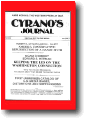
SELECTED EXCERPTS
AT LONG LAST, CYRANO/FIRST EDITORIAL --The Editors
THE PACKAGED CONSCIOUSNESS-
Herbert Schiller
COUP D'ETAT, AMERICAN STYLE-
Bertram Gross
REFLECTIONS ON CAPITALIST CULTURE-
Donald Lazere
KEEPING THE LID ON THE WASHINGTON CONNECTION--Noam Chomsky, Ed Herman
FIRST CATALOG OF US MEDIA BIASES, DISTORTIONS & SUPPRESSIONS--Patrice Greanville
|